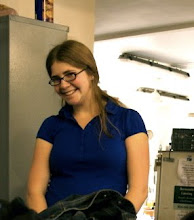
Coming at you live from Aroma (Israel's #1 coffee chain) in Kanyon Hadar, the mall across the street from Pardes. I've designated 12pm-1pm on Sundays and Wednesdays as class-free, an hour off - which, as all of you camp people know, is for iced coffee and checking email.
Once a week, I volunteer in an absorption center for Ethiopian immigrants (olim) in Mevasseret Zion, a small city not so far from Jerusalem. The families live in the absorption center (mercaz klitah) for 2 years after arriving in Israel. Several Pardes students go every Tuesday afternoon and spend time with the families and the kids there. My family has 5 kids, 4 of whom live at home - Isubalo (11), Tadla (8), Haftamo (3), and an infant. The Ethiopian community in Israel has not been well-absorbed into Israeli society - even after leaving absorption centers, they still live in relatively close-knit and isolated communities. They are poor and the adults speak very little Hebrew. Upon arrival in Israel, the Ethiopians were forced to undergo conversion, because their halachic Jewish status was questioned. Conversion in Israel is controlled by the rabbanut, the state rabbinic authority (and is currently in the news a lot) - those who convert in Israel are required to maintain a certain level of Jewish observance. As a result, the kids in the Ethiopian community in Mevasseret attend religious schools.
This past Tuesday, we took our kids outside to play, to the delight of every other child in the neighborhood, who couldn't wait to play with our jump rope, climb on the human jungle gyms, and ask us a million questions about where we were from, what we were doing there, and if we were coming back next week. Shira (another Pardes student volunteering there) and I were sitting on the curb chatting, when three older girls, probably around 13 or so, walked up and started to ask us the same million questions. With one new question: את דתית? (Are you religious?) I was wearing a skirt, which probably prompted the question. It's a tricky question to answer here. The word "דתי" isn't just an adjective, but a label that corresponds most closely with modern Orthodox. Particularly for these kids in the absorption center, where B'nei Akiva, the religious Zionist youth movement, has a significant presence, "religious" has a very particular social meaning. The kids hadn't heard of Reform Judaism, despite the fact that there is a vibrant Progressive synagogue in Mevasseret Zion, that I visited a few weeks ago for Shabbat with Shir Tikva.
It's a common question, especially when I tell Israelis that I'm studying Talmud and Torah at Pardes. I've been asked it when sitting in a bar on a Friday night (not usually the favorite stomping ground of the religious). Adult Israelis (as opposed to teen girls in the absorption center) have usually at least HEARD of Reform Judaism (reformim as they're called here), but are less likely to have some knowledge of what it means when I say that I'm a Reform Jew.
Breaking down religious stereotypes since 1986...
Today is our last normal class day until after Pesach - tomorrow we have a day of classes about Pesach (including a showing of The Prince of Egypt!), and then it's vacation! Vacation plans include a trip to the Golan Heights with Pardes, a long weekend in Turkey with Benn, seder, visitors from Boston, and some traveling around Israel. It's definitely spring here in Jerusalem: trees are green and blooming, the weather is significantly warmer (already hit high 80s!), and it smells like flowers everywhere. When I tried to buy cake mix last week to bake a birthday cake for a friend, I failed at the first grocery store I went to - they had already cleared out the chametz from several of their aisles, replacing it with kosher for Passover cake mix - gross!
Sunday, March 14, 2010


Thursday, March 4, 2010
Haredim and Hamentaschen
Haredim...
Last week, my friend and fellow Pardes student Dan and I joined a group of leaders and staff from the Jewish Agency's Board of Governors meeting to take a tour exploring ultra-Orthodox (haredi) life in Israel. The tour took us to a girls' school in the haredi Jerusalem neighborhood of Geula, a business employing primarily haredi women in Modi'in Illit, and an employment center in Beit Shemesh. I learned a lot more on the trip than I was expecting, especially since Dan and I had been told that our primary role in being there was to talk about the impact that MASA (a project of the Jewish Agency and the Israeli government that is one of the key financial reasons that enables me to be in Israel now) has had on us. It was a great opportunity to see a slice of Israeli life that I don't come into much contact with in my life in the liberal, pluralistic community of South Jerusalem.
The haredi community is usually very separate from the rest of Israeli society (or the society of whatever country they are living in). They live in tight-knit communities, marry within their communities, and remain within the haredi world for employment, avoiding contact with the secular world. This can be seen even by looking at the itinerary for my day exploring the haredi world. Our first stop, Geula, is a Jerusalem neighborhood inhabited almost entirely by various sects of the haredi community. The second location, Modi'in Illit, is an entirely ultra-Orthodox city/settlement, on the other side of the Green Line. It has a population of 50,000, and is the fastest growing city and settlement in Israel.
The common thread among most of the places we visited was how haredim can participate in modern society while still remaining within the haredi community. In Modi'in Illit, we visited CityBook, a business that hires haredi women to do legal work that has been outsourced from an American real estate company. 10-15% of the work force is out on maternity leave at any given time, due to the emphasis on family and childbearing in the haredi community! I was really struck by how the company made both halachic (Jewish law) and cultural adjustments to their offices in order to be a viable employment option for these women. After consulting with rabbinic authorities, they put glass windows into all of the office doors, to enable a man and a woman to have a private business meeting without violating Jewish laws about men and women being alone. Culturally, they set aside a room in the offices for women to use when coming back from maternity leave for pumping breast milk, instead of using a closet or trying to find other private space like women in so many other offices have to do. That's not a legal adjustment, but it is acknowledging the cultural realities of the community. One of the women employees raised the point that haredi women have always entered the workforce; historically they were expected to be the family's primary breadwinners while the husbands studied fulltime in yeshivot. What's different now is that the community and businesses are approaching it on a more collective level, by placing offices and businesses in places that are physically the center of haredi life. The business even receives subsidies from the Israeli government, which wants to encourage employment of minorities, including the haredi and Arab sectors of the labor force.
In Beit Shemesh, we met with three soldiers from the Israeli Defence Forces unit Nahal Haredi. The rabbi who founded it (originally from Boston!) wanted to address the rift between the secular and religious parts of Israeli society. One of the biggest points of contention is army service - most ultra-Orthodox men don't serve in the IDF, unlike the rest of their peers who serve in some way, either through enlisting in the IDF or doing national service (volunteering in some part of Israeli society). A popular bumper sticker in Israel, reflecting this tension, reads "גיוס לכולם - Enlistment for All." This special army combat unit was created to make a space for haredi young men to serve in the army without having to compromise their religious practices and cultural standards. The unit is 70% haredi and 30% national religious (modern Orthodoxy in the US) - but everyone is religious. One of the soldiers said, "This is not the place for non-religious guys looking to spend less time in the army." The soldiers do two years of combat service, and their third year in the army focuses on vocational training and completing their high school diplomas, so that post-army, the men who participate in this combat unit can enter the workforce. In Israel, it's very difficult to enter the labor force in a meaningful way if one hasn't served in the army, and for haredi men, they have not studied secular topics or gained any marketable skills other than learning gemara.
It struck me the extent to which Nahal Haredi has caused the IDF to change, rather than creating change within the haredi community itself. These are two social institutions in Israel that, at least at face value, are incompatible. The army adjusted to make space for the haredi world, rather than the haredi world adapting itself to the army. Although the unit has been around for 10 years, they still struggle to recruit young men to it. Those who come are often those who haven't succeeded in yeshiva, and like young people in any society who don't succeed on their expected path, are drawn to drugs, drinking, fighting, etc. (instead of addressing potential learning disabilities or different aptitudes that might lead to a young man not thriving in a yeshiva environment). Many of the soldiers are told by their families to not come home, and if they do, to not come home wearing their army uniforms. There is a lot of anger and embarrassment still within the haredi community to some of their sons participating in Israeli society in this very basic way.
The funniest moment of the day occurred as we were leaving lunch with the haredi soldiers. They are young men, look like any other young Israeli soldier - wearing small kippot, very clean-shaven, have the sleeves of their army uniforms rolled up as far as possible (it shows how macho you are, obviously. Only weaklings roll their sleeves down). I asked a question of the speakers and got a rushed answer because we needed to be leaving. As I was collecting my things, one of the soldiers came over to me and very eagerly said, "What was your question? I can answer it!" I was dressed my most modestly for the day - long denim skirt, carefully layered shirts, looking very much the part of a modest Orthodox young woman. I thought, "You don't want this, honey. I know it looks like you do, but you really don't...I'm going to be a Reform rabbi, I study gemara...really, really not your type!"
...and Hamentaschen!
Last weekend was Purim! In Jerusalem, this resulted in a four and a half day weekend! We had a half-day of school on Thursday due to the Fast of Esther, no school on Friday and Saturday as usual, Sunday off for Purim, and Monday off for Shushan Purim. Shushan Purim is celebrated in walled cities (such as Jerusalem), in recognition of the fact that the Jews of Shushan (the walled Persian city where much of the Purim story takes place) had an extra day to pursue and kill their enemies than Jews in the rest of Persia. Excellent. Sheryl and I went to the shuk on Thursday afternoon; I had to buy ingredients for the Shabbat lunch I was hosting as well as materials for mishloach manot (packages of food and treats sent to friends and neighbors on Purim). The candy store was PACKED with others looking for the same thing. The next day, on Friday, as I walked past the high school near my house, I saw a teenage girl run out of the Purim party/carnival to pick up some baked goods from a parent waiting in a car in the street. Her costume? Sexy Santa.

Noam and I in our costumes (he's the Rambam!) at Kol Haneshama megillah reading - Terry told me it looked like I wasn't in costume, I had just walked into the wrong synagogue!

Women's megillah reading at the Kotel
Tuesday, February 23, 2010
Taking it to the street
Last week, on Rosh Hodesh Adar (the first day of the Hebrew of Adar), I had multiple opportunities to get out of the beit midrash - where, contrary to what you might think from reading this blog, is where I spend most of my time.
That morning, along with several other Pardes students and other friends from around Jerusalem, I prayed with Women of the Wall. (see this post for more about WOW) It was a beautiful, unseasonably warm and sunny morning, a welcome change from the torrential rain of Rosh Hodesh Kislev. After, many friends, both in Israel and back home, asked how it was, and my immediate response was "uneventful." Considering that the first time I joined the Women of the Wall, Nofrat was arrested, anything else after that is relatively uneventful. In reality, there was a huge crowd of women (and a significant number of male allies) present to welcome in the joyful month of Adar with song, prayer, and dancing, and many on both sides of the mechitza who verbally and physically protested against our prayers.
And for a laugh, check out this Youtube video (starring me!).
That morning, along with several other Pardes students and other friends from around Jerusalem, I prayed with Women of the Wall. (see this post for more about WOW) It was a beautiful, unseasonably warm and sunny morning, a welcome change from the torrential rain of Rosh Hodesh Kislev. After, many friends, both in Israel and back home, asked how it was, and my immediate response was "uneventful." Considering that the first time I joined the Women of the Wall, Nofrat was arrested, anything else after that is relatively uneventful. In reality, there was a huge crowd of women (and a significant number of male allies) present to welcome in the joyful month of Adar with song, prayer, and dancing, and many on both sides of the mechitza who verbally and physically protested against our prayers.
There's a tradition that when Adar enters, joy increases, reflecting the joyousness of the Jewish community at having escaped genocide at the hands of Haman in the Purim story, and the general fun and craziness that accompanies the celebration of Purim today. That joy was definitely present that morning - with the warm (almost hot!) sun, we sang Purim songs "מישנכנס אדר מרבים בשמחה - when Adar comes in, we increase in joy!" as we walked the Torah to Robinson's Arch, the archaeological site next to the Kotel that has been designated for egalitarian and women's prayer and Torah services. Despite the anger that I heard and saw at the Kotel - several ultra-Orthodox women literally pushed their way into our group to try and disrupt our davening, while a large group of haredi men, armed with a megaphone, bellowed "GEVALT" (like oy gevalt - Yiddish for things that are really bad), yelled that we weren't Jewish, and that there is one Torah and it cannot be changed - the predominant emotion among the women I prayed with on Rosh Hodesh was that of the joy that one could find in any synagogue in Jerusalem on the morning of Rosh Hodesh Adar.
The same day, Pardes as a community had a "Yom Iyun shel Chesed" (translation: Mitzvah Day), in memory of two former Pardes students who were killed in a terrorist attack at the Hebrew University in Jerusalem in the summer of 2002. That afternoon, I got on a bus with 50 other Pardes students, faculty, and their family members to go to a farm outside of Rehovot to pick produce for an organization called Leket. Leket, whose name comes from the commandment in the Torah to leave behind in your field the produce that falls or doesn't get picked in the harvest for the poor of the community to glean, is a food rescue organization that collects produce from farms and leftovers from parties, wedding halls, etc. We visited a farm that exists purely to provide fruits and vegetables for those lacking food security, and spent the hot afternoon picking oranges (and eating a couple). It was great to be able to be outside on such a beautiful day, and we picked 3 TONS of oranges, which were distributed into kids' lunches for school the next day.
One of the challenges I've had since even getting to Pardes was thinking about transitioning from working and acting in the world to sitting and learning, for its own sake, full-time. This was compounded when Rav Landes, the rosh yeshiva at Pardes (the #1 in charge), in talking about etiquette in the beit midrash to the whole community, included among his etiquette rules that not only should cell phones and email not be used in the beit midrash, but the news shouldn't be read also. For me, my study of Jewish text in the beit midrash is incomplete without that connection to the rest of the world. Yes, I am studying Torah for its own sake this year, but not with blinders on. Pardes does not constrain its activities to the beit midrash - Yom Iyyun shel Chesed, and our weekly volunteering (there are no classes on Tuesday afternoons, and most students volunteer at various non-profits in and around Jerusalem). Reflecting on my time so far in Jerusalem, particularly through talking with Rabbi Gold and Shir Tikva's 11th and 12th graders while they were here last week, I realized that I really haven't limited myself to my learning in the Pardes beit midrash. Through my volunteering (more on that in a future post), time with Women of the Wall, and involvement with Encounter, I've embraced a teaching that Rabbi Gold shared with me last year: "My Torah is walking - I'm following it to the public square."
In that spirit...
Pardes is doing a community learn-a-thon this week to raise money for Haiti relief through AJWS, American Jewish World Service. As a community, we are all doing extra learning, our teachers are donating their time to teach evening classes on social justice issues, and we are reaching out to our friends and families to donate money in support of us and this dire humanitarian crisis. You can donate here.
Friday, February 19, 2010
West Bank Story
A tale of two cities...Bethlehem and Efrat. Two weeks ago, I spent two days in Bethlehem with Encounter, an organization that brings Diaspora Jewish leaders to Bethlehem to hear and experience Palestinian narratives and life. The following Shabbat I spent in Efrat, at the home of one of my teachers from Pardes.
View West Bank Story in a larger map
Encounter was a challenging and intense experience. One of the most powerful parts of the trip was listening to a panel of Palestinian women activists, sharing their own personal and professional narratives. One woman, Rula, shared how she, an East Jerusalem resident, gave birth to her son in East Jerusalem when her husband was living in Jordan. Because the father's identity was bureaucratically "unknown," Rula couldn't get a birth certificate or an Israeli ID for her son. If she traveled to Jordan to reunite her son with his father, he'd lose any chance to have documentation. As a result, the only solution was for Rula to divorce her husband, and she finally got papers for her son when he was 5. She said, "Ask any woman if she'd pick her husband and her son - her son! I don't want my son to be added to the refugee list."
Sheerin, who currently works for the UN in Darfur, offered one of the hardest to hear stories, simply because of the hopelessness that she voiced. She told of how her niece asked her, "Why are they doing to us?" Sheerin said, "10 years ago, I would have thought carefully about how to answer...now, I just say they hate us." She doesn't think non-violent activism will work, and is frustrated without any answers, solutions, or ways to move forward. She chose to leave her home village outside of Bethlehem, and was faced with a choice between San Francisco and Darfur. She chose Darfur, because she wanted to see what it felt like to be an outsider to a conflict. Sheerin described how here (in Israel/the Palestinian territories), she's the weakest - she is black (relative to those who are in power) and Palestinian. In Darfur, it's the opposite. She has power, she is white (relative to those who are the victims of the genocide in Darfur), she is Arab and Muslim, she works for the UN. In Darfur, it's hard for her to be associated with Arabs, and connected with those who are committing genocide and human rights abuses. It was very hard for me to hear what she said about not wanting to be Israeli and have oppression done in her name. It raises deep questions for me about what is done in my name, for my sake, that I may or may not agree with. I believe in a Zionist ideal, a Jewish state that lives up to the highest prophetic values of Judaism with respect for the dignity of every human being, and there are so many examples that I see here, day after day, not only with respect to the Palestinian territories, that aren't living up to that expectation.
The State of Israel will be open for Jewish immigration and the Ingathering of the Exiles; it will foster the development of the country for the benefit of all its inhabitants; it will be based on freedom, justice and peace as envisaged by the prophets of Israel; it will ensure complete equality of social and political rights to all its inhabitants irrespective of religion, race or sex; it will guarantee freedom of religion, conscience, language, education and culture... -Declaration of Establishment of State of Israel
My home stay, with an older Muslim couple in Beit Sahour, a city just east of Bethlehem, presented a much more optimistic perspective. Atala, who teaches Islam in a Christian school, where his students are both boys and girls, Muslims and Christians, believes that religion can bring us together. We all pray to the same Divine power, we all pray for peace every day. His and his wife Jamila's hospitality was lovely - even though we were full from dinner when we arrived, they made delicious tea, we ate fruit and candy next to their fireplace, and then in the morning, I ate so much bread, eggs, tomatoes, and salads that I wasn't even hungry when it was lunch time.
On Friday, we heard a panel of non-violence activists. One shared a story of driving through a checkpoint, and the soldier asked him something along the lines of "How do you deal with it? Isn't life awful for you?" He responded, to an Israeli soldier who grew up in a settlement outside of Hebron, "How do YOU stand it? Standing outside, in the rain, on a cold winter day?" And the soldier cried, because the Palestinians whose papers he checked all day long had never recognized his pain and asked about him.
The stories and realities that I heard were painful, inspiring, depressing. Sometimes they conflicted with the stories and realities that I have learned over the years. The takeaway message, as I discussed with Rabbi Neal Gold last night (Shir Tikva's 11th and 12th graders are in Israel for the week, it's been great to see and spend time with them. Looking forward to Shabbat with the group!) is: it's complicated, and anyone who thinks it isn't is missing something.
Shabbat in Efrat, after spending 2 days in Bethlehem seeing how West Bank settlements and their growth are having serious consequences for Palestinian life, was challenging. My friend and fellow Pardes student Amy and I went to our teacher Hindy's house in the north of Efrat, a neighborhood called Zayit. From the windows of the synagogue where we went to services, we could see Jerusalem...and Bethlehem. Hindy are her husband are liberal, West Wing-lovers, but it was impossible for me to forget that I was in Efrat, in a settlement in the West Bank. This is a small country, and everything is very close, yet very removed. Efrat and Bethlehem are totally different worlds. Not everyone moves there for deep, ideological reasons - Hindy and Mark moved there because they needed more space than they could afford in Jerusalem, where housing costs are skyrocketing. But the political still comes out, in the form of self-interest: as we left shul on Saturday, Hindy and Mark grumbled about the overcrowding in their synagogue, and as we walked home, pointed out the site that their new synagogue will be built on...but can't be built yet, along with a lot of other planned construction, because of the settlement freeze. this contrasted sharply with my visit the week before to the Hope Flowers School in al-Khader, a village next to Bethlehem, which is in the path of Efrat's future growth, and could face serious problems with access if Efrat continues to grow north. The view outside of one of the windows in Hindy's apartment faces an Arab village, so close that we could clearly hear every word echoing from the minaret throughout the day.
View West Bank Story in a larger map
Our Shabbat overall was lovely - I had a great time with Hindy, her husband, and her cute kids (even though they didn't like me very much), and Amy and I went for a walk in the unseasonably warm February weather on Shabbat afternoon. All of these stories are part of the narrative of this confusing place, even when they conflict with each other.
Monday, February 1, 2010
לשנה הבאה בירושלים - To Next Year in Jerusalem!
First off, an exciting announcement! Yesterday I interviewed for the rabbinical school at Hebrew Union College-Jewish Institute of Religion. I felt great about the interview itself, and left expecting to receive a letter in the mail in about 2 weeks (although let's be honest, with Doar Yisrael, it would've been more than that). Much to my surprise, I got a call around 10:15 last night, informing me of my acceptance! Here's to another year in Jerusalem (and of this blog!), and the next step on this wonderful, holy journey. The amount of love and support from my friends, family, teachers, and mentors over the past several months through the application process has been incredible, thanks to all of you for teaching, challenging, loving, and holding me.

"In order to love Jerusalem, you need to leave it."
These wise words from another friend studying in Jerusalem sent me off to the desert again over our semester break a few weeks ago, this time to Kibbutz Ketura, a pluralistic kibbutz (communal living arrangement, historically socialist, much less so now in most cases) in the Arava Valley. I spent the first few days spending time with family, both those living on kibbutz and the Jerusalem family down visiting for the weekend. While I was there, we were blessed with a huge rainstorm - rain? in the desert? The anticipation around the kibbutz the day before was like in the Northeast the day before a huge blizzard (in fact, the kids even had a rain day from school on Monday!) I saw flowing rivers, waterfalls, and even had the chance to add some new words to my Hebrew vocabulary: a מפל (mapal) is a waterfall and a שיטפון (shitafon) is a flash flood. It rained all over the country that week, leading to the excellent news that Yam Kinneret (the Sea of Galilee) has risen almost a meter in the past two months. My cousin Shimon, a guide on the kibbutz, said he saw waterfalls flowing that he had never seen before, and that it was more rain than the kibbutz had seen in over a decade.


Friday, January 15, 2010
"Let the peoples tremble...let the earth quake"
(Psalm 99:1)
This blog post was originally supposed to be about the drought here in Israel. The Sephardi Chief Rabbi of Israel declared yesterday, Thursday, a fast day. Rav Amar said, "Because of our sins the water situation is in a serious state. Our duty in this situation is to scrutinize and examine our actions and bring ourselves close to God with all our hearts. We must be repentant with broken hearts and anyone who is able should fast, if not a whole day, at least a half day." This is a tradition, that when winter hasn't been wet enough, the chief rabbi will call for the entire country to fast (which doesn't happen) in hopes of bringing the rain. I was going to write about communal responsibility taking care of our world, both spiritually and practically.
But then a 7.0 earthquake hit Haiti. If I were in the States this weekend, any synagogue that I might find myself in for Shabbat would be acknowledging the crisis and suffering, praying for the people of Haiti. In comparison with the tens of thousands dying under rubble, praying for rain, for this one teeny country, seems selfish and insignificant. No one is dying, today, because of the drought in Israel. Yet the drought is systemic, and absolutely affects people's lives and physical well-being. When I pray the words of the Gevurot, משיב הרוח ומוריד הגשם - Who causes the wind to blow and the rain to fall, my intention is not only towards Israel, but towards this whole, dry region. In the West Wing episode, "College Kids," President Bartlet shares his daughter Ellie's teacher's opinion on why there's always been conflict in the Middle East: "It's because it's incredibly hot and there's no water."
The tradition of declaring a communal fast day in times of drought in Eretz Yisrael is rooted in the assumption that the drought is because of our human failings, as individuals and as a community. The liturgy is not in ecological terms, although many interpret it as such, but in the language of sin and forgiveness. When this language is contrasted with Pat Robertson's words about how Haiti deserved this as punishment for a pact with the devil, I'm challenged by the theology inherent in these fast days, that droughts are a punishment to Israel because of sin, whether the sin of not keeping Shabbat, of sinat hinam (senseless hatred), or the treatment of the Other. But I do believe that how we act communally impacts the world. It's easy to think of examples for the drought, especially since it requires all of us to collectively reduce water usage through lifestyle changes. My friend Josh G-S saw a greater distinction between the fast day and Robertson's words than I did. He pointed out that the fast day comes from within the Jewish community, rather than from an external individual accusing an entire country of sin. We call on ourselves to take stock of our actions, through prayer and fasting.
Rabbi Jonathan Sacks writes in his commentary to the prayer ברכת השנים (blessing the years, in the Amidah) in the Koren siddur, that, "Israel is a place that teaches its inhabitants the need for prayer." So is the world. Both of these natural events cause people of all faiths to cry out in prayer. In my siddur class this past semester, we talked about the power of prayer, and whether or not it has tangible impacts on the world. We talked about how our prayers can change us, by reminding us of our ideal selves and the world as we believe it should be, and through that, change the world.
Yesterday at Pardes we said tehillim, psalms, for both those suffering in Haiti and for ending the drought in Israel. Isaiah asks, "Is this the fast I desire?" Hopefully, the fast day, the psalms, the prayers for Haiti will lead to not only prayer and introspection, but real, world-changing action.
Blessed is God, Ruler of the Universe, whose power and might fill the world.
Wednesday, January 6, 2010
Life's a Great Balancing Act
At a night encampment on the way, the Lord encountered him and sought to kill him. So Zipporah took a flint and cut off her son's foreskin, and touched his legs with it, saying, "You are truly a bridegroom of blood to me!" And when God let him alone, she added, "A bridegroom of blood because of the circumcision." ~Exodus 4:24-26These verses, towards the end of this week's Torah portion, Sh'mot, have always seemed weird to me. They are out of place, a break in the narrative of Moses' first encounter with the Divine at the burning bush and his development as a leader.
In my chumash class at Pardes, we've been studying the book of Exodus all semester. More specifically, we've been studying Parshat Shmot all semester - we completed the first Torah portion of Exodus this week, just in time for it to be this week's portion. Studying it in this up-close, in-depth way gave me the chance to look at these verses on their own, rather than focusing on trying to place them within the narrative.
Rashi, the 12th century French commentator, in trying to understand why God is seeking to kill Moses, who has just been sent off to Egypt to free the Israelites, says that Moses didn't circumcise his son like he was supposed to, 8 days after his son's birth. However, he quotes Rabbi Yossi saying, "God forbid Moses was negligent! Moses said, 'I'll circumcise him and then I'll go out on a journey that's dangerous for the baby for the 3 days after his circumcision, instead I'll circumcise him and then stay put until he heals.'"
There's a conflict here between Moses' mission for the community and his responsibilities to his family and his son, a conflict that many people are personally familiar with. Moses' attempt to balance his communal and personal responsibilities almost led to his death! According to Rashi, these two are irreconcilable.
Ibn Ezra, a Spanish contemporary of Rashi, understands these odd verses by saying that circumcision can be postponed if the baby is ill or traveling, and that therefore Moses didn't circumcise his son on the 8th day so as not to delay in carrying out his mission from God. Ibn Ezra suggests that a messenger of God came to remind Moses to circumcise his child and then go on alone to Egypt, leaving the baby to recover with his mother at the night encampment. Ibn Ezra does not view the family's needs and the community's needs as completely in conflict, and finds a compromise allowing Moses to fulfill both, without neglecting his son or the Israelite people. This compromise requires the support of a third individual, Moses' wife Tzipporah, but with her help, he's able to find some balance in his life and his work.
Subscribe to:
Posts (Atom)

 Posts


